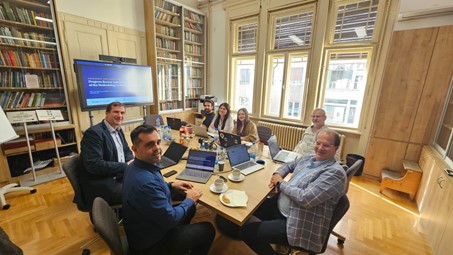
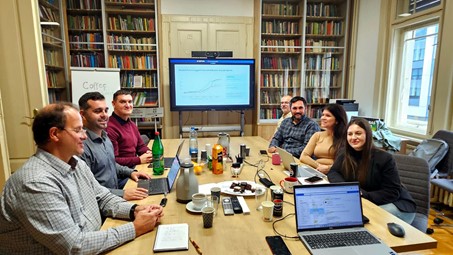
The Institute of Economic Sciences (IEN) in Belgrade hosted the second methodological workshop of the project "CEI Support to Taxation Policy Knowledge Transfer: Strengthening Public Revenues through Evidence-Based R&D" from 19 to 22 October 2026. The workshop was organized within the framework of the Central European Initiative (CEI) Know-how Exchange Programme (KEP) and brought together researchers from the Institute of Economic Research of the Slovak Academy of Sciences (IER SAS) and IEN. Nine researchers from both institutions took part.
The week built on the first workshop held in Bratislava in May 2026 and on the bi-weekly online consultations since then. On the first day, the partners reviewed progress and the adaptation of the Slovak modelling framework to the Serbian context, including the back-cast of Serbian gambling turnover and fees to 2010. In the afternoon, the teams jointly estimated a pilot gambling elasticity model covering the price elasticity of demand, the buoyancy of fees with respect to the tax base, and the link between the tax base and income, followed by a 2026–2030 simulation of gambling fees. The discussion also covered how to treat the fast-growing online segment and the potential implications for minimum tax thresholds for online operators.
On the second day, the programme extended to other excise taxes. Household budget survey (HBS) microdata were presented as an alternative to aggregate time series for alcohol, fuels and energies, with discussion of unit-value prices, zero expenditures and the pass-through of excise duties to consumer prices. On the third day, the partners used small-group consultations to agree on the structure of the joint peer-reviewed article and to prepare the policy brief. On the final day, they validated the findings of the week, discussed how to translate them into adjustments of the modelling framework and into presentations for the relevant stakeholders, and prepared the groundwork for a policy roundtable in Belgrade.
The project is implemented by IER SAS as the know-how provider and IEN Belgrade as the know-how beneficiary, with the objective of strengthening evidence-based fiscal policymaking, improving public revenue analysis, and supporting Serbia's alignment with European standards of fiscal governance.